





A connected family has never been more visible—or more complicated—as social media reshapes how we share, communicate, and set boundaries with the people closest to us.
80% of American adults are active on social media—and it’s changed not only how we interact with friends, but with our families. Family relationships have always had friction. Now that friction has a comment section.
To better understand how digital habits are shaping family relationships, Gabb surveyed 1,000 U.S. adults about their experiences with social media, privacy, and communication—specifically those who stay connected with family through social platforms or messaging apps. While platforms help families stay in touch, they also introduce new pressures around visibility, expectations, and conflict. These challenges especially impact younger generations and parents figuring out what should—and shouldn’t—be shared online.
Key Takeaways
- Nearly 3 in 4 adults actively check a family member’s social media at least a few times per week, and more than 2 in 3 say they’ve felt monitored by a relative in the past year.
- More than half (55%) of adults have changed what they post because family members could see it, with the most common behavior being avoiding certain opinions or topics (29%).
- 76% of adults believe family should ask permission before tagging or posting about them, yet 40% admit they’ve posted about a family member without asking first.
- 83% say family group chats help them stay informed, but 51% feel pressured to respond quickly, and 36% say chats have sparked real-life arguments—a figure that rises to 58% among Gen Z, compared to just 14% of baby boomers.
- Only 40% of adults say social media has strengthened their family relationships in the past year, while 52% say it’s had little to no impact, and nearly 8% say it’s made things worse.
- Nearly 3 in 4 adults think parents share too much about their children online, and among those who grew up being “sharented,” over half say the experience has shaped how they approach privacy today.
- Less than 35% of adults feel very safe expressing their true opinions online when family members follow them, and nearly 19% say they don’t feel safe at all.
Keeping tabs: the rise of digital check-ins
Everyone casually checks in on their loved ones online, but for some, keeping tabs on family members is a daily task. Whether it’s parents watching their teenager’s TikToks or aunts catching up on their niece’s Instagram story, families are using social media to keep up with each other. However, when people notice that they’re being watched online, they don’t always feel that closeness.
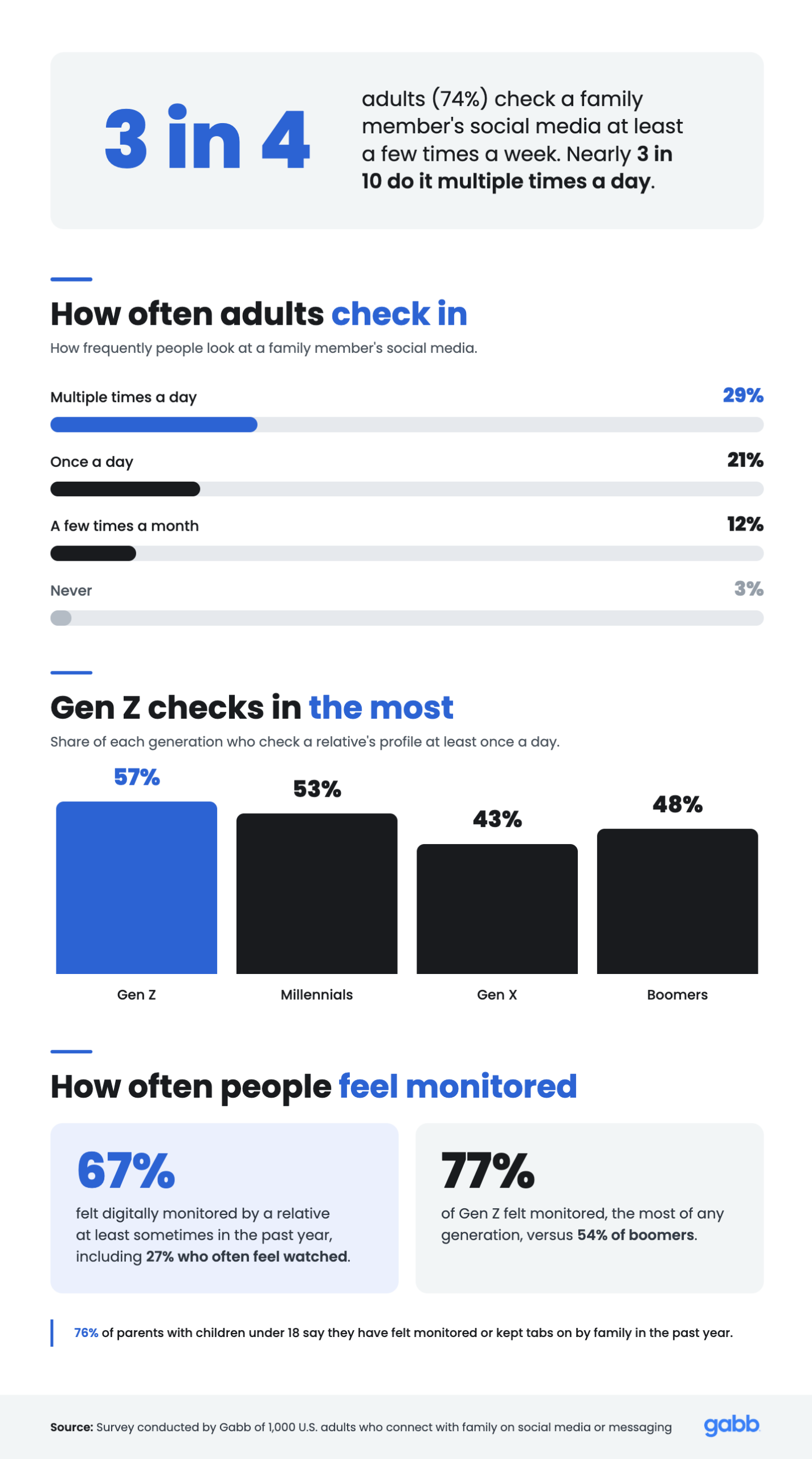
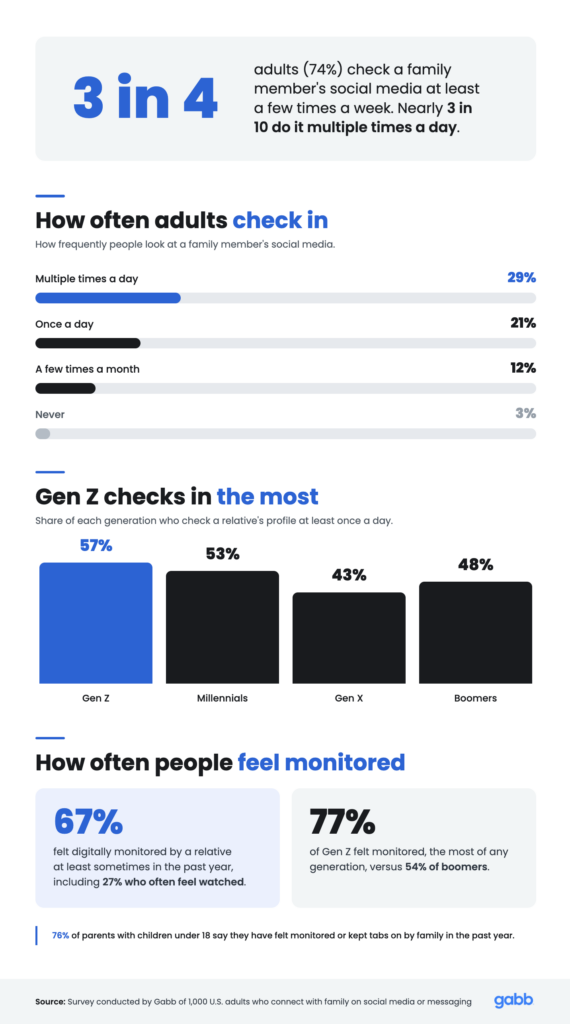
Nearly three-quarters (74%) of adults actively check a family’s social media pages multiple times a week, including 29% who check multiple times a day. Another 21% check once a day, and 12% say they only check up on their family members a few times a month. Gen Z was the generation most likely to keep tabs on their relatives, with 57% of Zoomers checking up at least once a day. This was the most of any generation, with 53% of millennials, 43% of Gen X, and 48% of boomers checking in each day. Only 3% overall said they never check their family’s social media profiles.
These check-ins aren’t going unnoticed. More than 2 in 3 (67%) digitally monitored by a relative at least sometimes in the past year, including 27% who often feel they’re being watched online. Among Gen Z, 77% felt digitally monitored at least sometimes, compared to 72% of millennials, 58% of Gen X, and 54% of baby boomers. Interestingly, there was a pattern among parents of all generations: 76% of parents with children under the age of 18 said they’ve felt monitored or kept tabs on by family members in the past year.
For far-flung relatives, social media may be the only way to watch grandchildren, nieces, and nephews grow up. But these check-ins aren’t going unnoticed—and for many, the feeling of being watched is changing how they show up online.
Posting with an audience in mind
According to a phenomenon called the Observer Effect, it’s common for people to change the way they behave simply because they believe someone is watching them. The same is true of humans interacting online. We asked our respondents if they experienced this phenomenon online due to their families’ observations, and it’s more likely than you may think.
Over half (55%) of adults have changed what they post because they know a family member is watching, rising dramatically to 78% among Gen Z. Zoomers outpace every generation when it comes to self-censorship: only 56% of millennials, 41% of Gen X, and 29% of baby boomers rein in their posts with family in mind. As the first generation of digital natives, Zoomers were told growing up that what they post on the internet will last forever, and it seems they took that to heart by significantly shaping what their digital footprint looks like to observers.
But what do these changes look like? Here are the most common ways people hold back online:
- Avoiding sharing certain posts or topics (29%);
- Not posting something they originally planned to share (23%);
- Blocking or hiding certain posts from family members (18%);
- Deleting or editing a post before publishing it (18%);
- Changing a caption to make it less controversial (16%);
- Creating separate private accounts or utilizing “close friend” lists (15%).
Gen Z was also the most likely to create private accounts or only make posts for their “close friends” list (35%). In comparison, only 2% of boomers admitted to this practice.
But even when people don’t change what they post, they often change what they can see. One in five (20%) people said they’ve muted or unfollowed a family member to avoid seeing their posts, rising to 28% among Zoomers. Another 16% has lost respect for a relative due to something they’ve posted, which may be why so many people self-censor online. The risk of losing someone’s respect—or worse, starting an internet fight—deters many from posting.
In fact, nearly half (46%) said they only feel somewhat safe expressing their true opinions under that kind of scrutiny, and fewer than 35% feel very safe doing so at all. The gap widens even more across gender lines: 30% of women feel very safe sharing honestly compared to 40% of men. Meanwhile, 23% of women say they don’t feel safe at all—significantly higher than the 14% of men who say the same.
For younger internet users, that discomfort escalates into conflict: 30% of Gen Z reported having argued with a family member over something posted online, compared to just 7% of Gen X and 5% of baby boomers. Despite curbing their own posts, Zoomers are more than comfortable airing their opinions in the comment section.
The rules families agree on—but don’t follow
There’s a nearly universal expectation that family should ask before tagging or posting about each other. Nearly everyone agrees—but only in concept. In practice, many family members are posting photos, milestones, and more, often without permission.
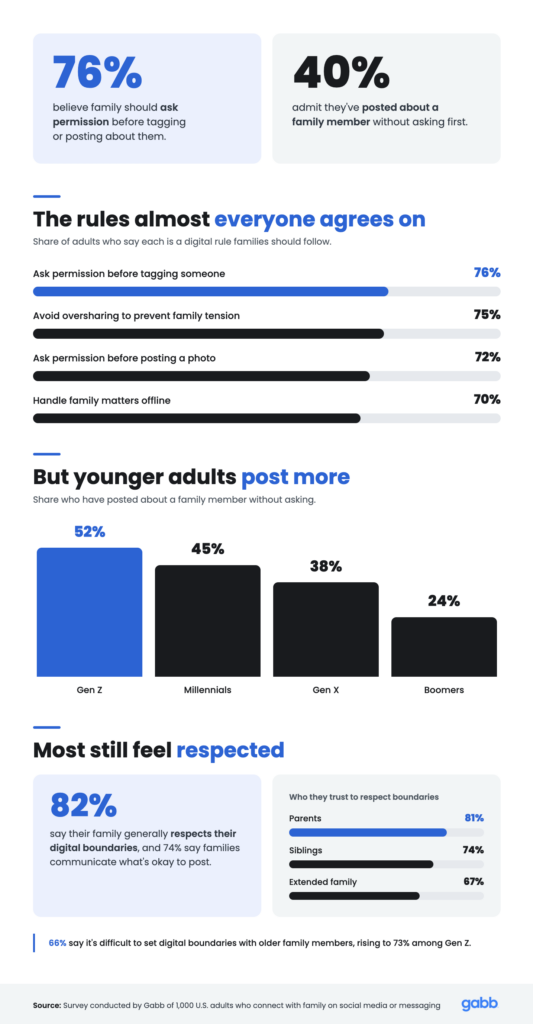
Some of the digital rules people believe in include:
- Asking permission before tagging someone (76%);
- Asking permission before posting a photo of someone (72%);
- Avoiding oversharing to prevent family tension (75%);
- Handling family matters offline (70%).
However, not everyone follows these rules in practice. Two in five (40%) admitted they’d posted about a family member without asking before, rising to 52% among Gen Z. This is over double the amount of baby boomers (24%) who had done so. This could simply be because they post more. A Zoomer may quickly upload a photo of a sibling or parent to their story while hanging out, or pick out a childhood photo for a surprise birthday post.
Despite this, older generations have earned a reputation for what they do post online. Over half of respondents (66%) said it’s difficult to set digital boundaries with older family members, with 73% of Gen Z and 68% of millennials agreeing. Another 58% overall said that their older family members tend to overshare online, while 61% said the same about their younger relatives.
On the whole, people feel respected by their family’s online behavior. The majority (82%) said their family generally respects their digital boundaries, and another 74% said their families clearly communicate what should and shouldn’t be posted online. This is strongest within the immediate family: 81% trust their parents to respect their boundaries, 74% trust their siblings, and 67% trust their extended family. While the rules around posting and privacy aren’t always followed to the letter, families are finding ways to navigate them with respect. There may be occasional overshares or blurred boundaries, but a willingness to communicate expectations keeps those relationships intact.
Group chats: connection with a catch
Texting all your relatives at once can be a great way to plan a reunion, but staying in the chat may lead to drama. Family group chats are meant to bring people closer together, and for the most part, they do. But for many American adults, this connection comes alongside conflict.
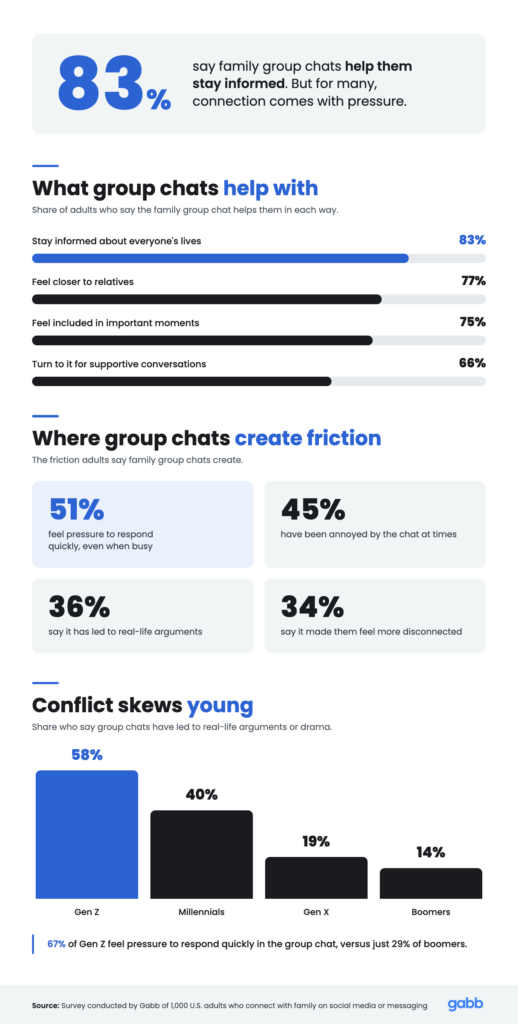
Most adults said their family group chats help them stay informed about everyone’s lives (83%), feel closer to their relatives (77%), and feel included in important moments (75%). Two-thirds (66%) said they turn to the family group chat for supportive conversations, rising to 68% among both Gen Z and millennials.
But for many, the support and connection exist alongside tension and conflict. Half (51%) of adults feel pressure to respond quickly, even if they’re busy, and 45% admitted that the group chat has annoyed them at times. More dramatically, 36% said that the group chat has led to real-life arguments, showing that even if families aren’t hashing it out in the Facebook comments, they may still be engaging in digital conflict. Over a third (34%) said that their family group chat actually made them feel more disconnected.
Gen Z is the most likely to feel pressure to keep up, with 67% saying they feel expected to respond quickly, compared to 53% of millennials, 39% of Gen X, and just 29% of baby boomers. They’re also far more likely to experience conflict—58% of Zoomers said group chats have led to real-life arguments or drama, versus 40% of millennials, 19% of Gen X, and just 14% of baby boomers. This could indicate that Gen Z is more likely to engage in conflict online, or that older generations downplay the tensions within these group chats.
Rethinking What Parents Share Online
Ever since social media became mainstream, parents have wanted to show off their children. The wave of early 2000s mommy bloggers led the way for the parenting influencers we see today, but now, their children are adults, and aren’t all happy about what was shared online. Among adults whose childhoods were documented online, that experience is shaping how they think about protecting their own kids.
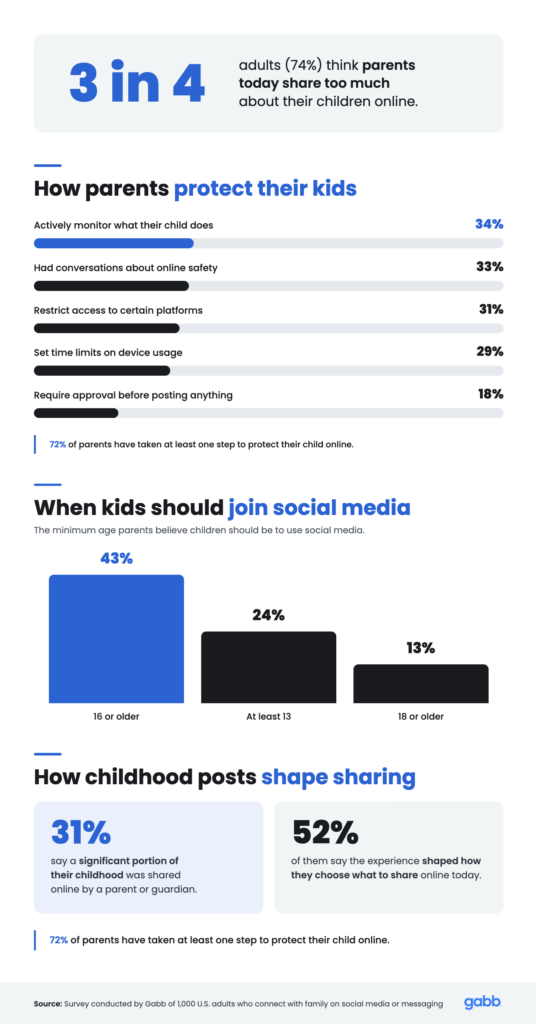
Sharenting Statistics: What the Data Shows
In a 2026 Gabb survey of 1,000 U.S. adults:
- 31% say a significant portion of their childhood was documented online by a parent or guardian
- 74% say modern parents share too much about their children online
- Among those who grew up “sharented,” 52% say it shaped how they approach their own privacy today
Nearly one in three (31%) say a significant portion of their childhood was shared online by a parent or guardian. Among those who grew up with parents who posted them online, 52% said it shaped the way they choose what to share online today. Overall, 74% said modern parents share too much about their children online. In the age of deepfakes and AI scams, sharenting can become not just obnoxious but dangerous.
That concern is influencing how parents manage their kids’ access to social media. Nearly three-quarters (72%) have taken at least one step to protect their child online. Among those parents, 34% say they actively monitor what their child does, while 31% restrict access to certain platforms altogether. A third of parents (33%) had conversations with their children about online safety, empowering them to make safe choices on the internet. Another 29% enacted time limits on their child’s device usage, encouraging them to explore their lives outside of a screen. Others had more rigorous boundaries, such as requiring permission and approval before posting anything online (18%).
Many parents support a minimum age for social media use, with 43% of parents believing that children should not join these sites until they’re at least sixteen. Another 24% said the minimum age should be thirteen, and 13% said children should not join social media until they are legal adults. Amid growing concerns about how social platforms are designed to make their apps addictive, these parents are helping their kids avoid a dependency on these platforms.
Does social media actually bring families together?
Social media, as the name suggests, is meant to enhance our social lives. But while the primary goal is to bring people together, online conflict can leak into the real world. For most people, though, social media has become an accepted part of everyday life.
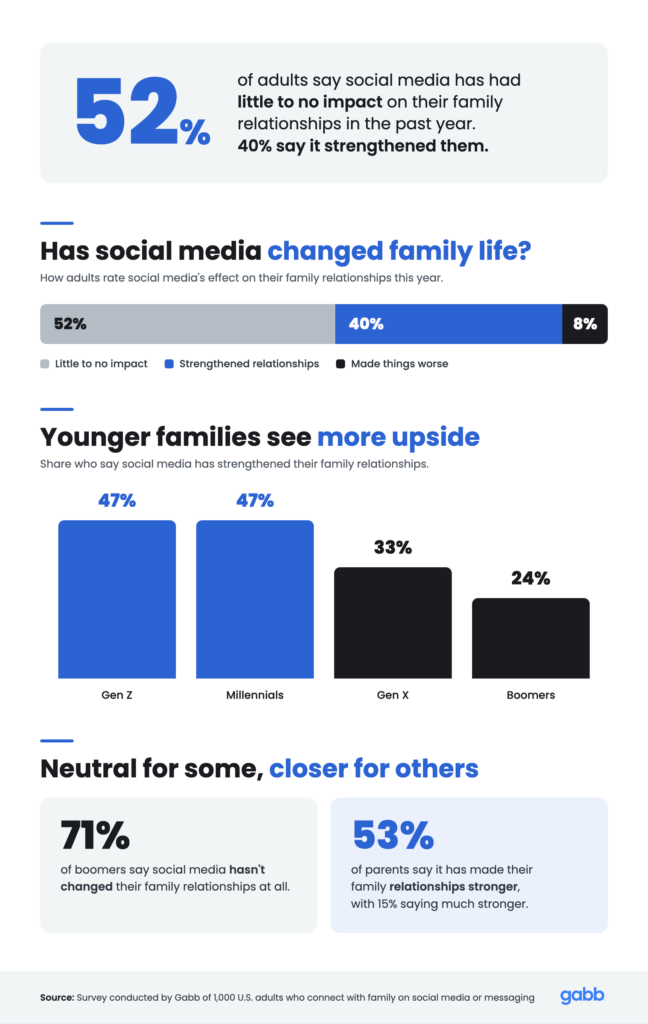
Two in five (40%) adults said social media has strengthened their family relationships in the past year, while more than half (52%) said it’s had little to no impact at all. Only a small number reported negative effects, with about 8% saying social media has made their relationships worse overall. For most families, social media is a neutral space, a virtual extension of the living room or backyard barbecue. It’s not the space that matters, but what they do within it.
That neutrality, however, looks very different across generations. Boomers are the least likely to feel any impact, with 71% saying social media hasn’t changed their family relationships at all and just 24% saying it’s made them stronger. Younger generations are more likely to see benefits, with 46% of Gen Z and 47% of millennials saying social media has strengthened their relationships. Among parents, 53% say social media has made their family relationships stronger, with 15% saying relationships are “much stronger.”
Ultimately, social media hasn’t dramatically reshaped family relationships in one clear direction. Instead, it’s created a mixed landscape where connection is possible—but so is conflict. Whether it helps or harms depends on how each generation uses and experiences these platforms.
Connected, but not always aligned
Across every generation, social media introduces new dynamics around privacy, boundaries, and trust. Over time, these dynamics influence how comfortable people feel expressing themselves and engaging with their relatives online.
The impact is especially pronounced for younger generations and parents. Gen Z is navigating the pressure of being constantly visible to their family while also managing the emotional weight of digital conflict, while parents are rethinking how much of their children’s lives should be documented online. As our habits evolve, one thing becomes clear: connection alone isn’t enough. Families need shared expectations around consent, respect, and communication.
Moving forward, small changes can make a meaningful difference. Asking before posting, setting norms for group chats, and creating space for honest expression without judgment can help families maintain both connection and trust. As digital life continues to mature, the families that navigate it best will be the ones that treat online interaction with the same care as in-person relationships.
Methodology
Gabb surveyed 1,000 U.S. adults who connect with family through social media or messaging apps to better understand how digital activity and social media use affect family relationships, privacy, and communication. The survey explored behaviors such as social media monitoring, self-censorship, group chat dynamics, digital boundaries, sharenting, and perceptions of social media’s overall impact on family bonds. The sample was stratified and segmented by age, gender, income level, and parental status, and results were post-stratified where applicable. Some subgroup analyses may reflect unweighted data, and percentages may not total 100% due to rounding or multiple response selections.
About Gabb
Gabb is a technology company focused on providing safer, age-appropriate watches and phones for kids. Its products are designed to help parents minimize kids’ exposure to harmful content and digital risks. By prioritizing safety and healthy tech habits, Gabb supports parents in navigating the challenges of raising children in a connected world.
Fair Use Statement
This content may be shared for non-commercial purposes only; if used, please credit Gabb and include a link to the original research.



Success!
Your comment has been submitted for review! We will notify you when it has been approved and posted!
Thank you!