a girl looking at her phone, showcasing how much average screen time teens have
Life Online
9 min read

Average screen time for teens: What parents should know

By Natalie Issa

In May 2026, the U.S. Surgeon General issued a public advisory warning that children and adolescents now spend as much or more time on screens as they do sleeping or in school. The number behind that line is probably higher than most parents expect: U.S. teens average more than eight hours of daily screen time—roughly 43% of their waking hours, according to Common Sense Media.

That’s not a crisis number on its own, but it’s not nothing either. Here’s what the data actually tells you, and what it doesn’t.

What’s the average screen time for teens?

The most recent comprehensive figures from Common Sense Media’s 2021 census put average daily screen time for teens aged 13 to 18 at 8 hours and 39 minutes—up from 6 hours 40 minutes in 2015. That’s all entertainment and social screen time; it doesn’t include school-required device use. (The Surgeon General’s advisory cites a slightly wider range of seven to nine hours, drawing from multiple national estimates.)

The breakdown within those hours matters as much as the total. According to a Gallup survey of more than 1,500 U.S. teens, the average teen spends roughly 4.8 hours per day on social media, and nearly two of those hours are on TikTok alone.

Hours on schoolwork or video calls with friends read differently than hours of passive social-media scroll, and the research increasingly supports that distinction.

How teen screen time has changed over the years

Teen screen time has risen for roughly a decade. From 6 hours 40 minutes in 2015, to 7 hours 22 minutes in 2019, to 8 hours 39 minutes in 2021—that’s nearly two additional hours per day over six years. (The teen numbers are the steepest end of a trend that starts much younger.)

COVID accelerated the increase. A JAMA Pediatrics systematic review covering 46 studies and roughly 29,000 children and adolescents found an average increase of 84 minutes per day during the pandemic, with the steepest rises among 12-to-18-year-olds. Post-pandemic figures haven’t fully reversed it.

Some reporting suggests a modest downward trend starting in 2023–2024, but comprehensive data confirming a durable decline isn’t yet available.

Breakdown: Social media, TikTok, video, and gaming

A rough breakdown for the average teen looks like this: social media takes up around 4.8 hours per day, per Gallup.

Of that, TikTok claims roughly 1.5 hours according to Gallup’s teen-reported data, though Qustodio’s parental-controls data—which tracks actual device usage among the families using its software—puts U.S. kids at around 2 hours on TikTok daily. (Qustodio’s sample is its own user base rather than a representative survey, so it’s directional rather than population-wide).

TV and video account for 3-plus hours.

Additionally, gaming takes up a significant chunk, especially for boys. Texting and video calls are embedded in social platforms but also stand alone.

The relevant point for parents: screen time is a single bucket for highly varied behavior. Two hours of Minecraft with friends after school, a 45-minute Zoom homework session, and three hours of TikTok at 11 p.m. are all technically screen time, but they don’t land the same way.

How screen time differs between teen boys and girls

Boys skew higher in total hours, mostly because of gaming. Teen boys average around 9 hours 16 minutes of total screen time versus 8 hours 2 minutes for girls, per Common Sense Media’s 2021 census.

Girls skew higher in social media use specifically: about 5.3 hours per day versus 4.4 hours for boys (Gallup). The mental-health research on social media tends to show stronger associations for adolescent girls, which is useful context when calibrating where to look.

What the research says about teen screen time and health

Three findings are worth knowing about, each with a caveat.

Sleep is the most consistent finding

A 2025 analysis by CDC researchers, published in Preventing Chronic Disease and based on the National Health Interview Survey-Teen, found that 59.9% of teens with four plus hours of daily screen time reported being infrequently well-rested, versus 40.1% of lighter users.

Irregular sleep routines showed a similar gap: 49.2% versus 29.2%. The mechanism is straightforward—blue light, stimulation, and late-night usage delay sleep onset. This is the effect parents can observe most directly. The Surgeon General’s recent advisory specifically flags that most adolescents now report using their devices right before bed.

Mental health associations exist, but the pattern matters more than the hours

The same CDC analysis found recent depression symptoms in 25.9% of high-screen-time teens versus 9.5% of low-screen-time teens—a notable gap, also reported in the companion NCHS Data Brief No. 513.

But some researchers argue that how a teen uses screens matters more than how much. Compulsive checking, using screens to regulate emotions, and feeling anxious without a device may predict negative outcomes more reliably than total hours. “My kid spends a lot of time on screens” is a weaker signal than “my kid seems distressed when the phone is away.”

The Surgeon General’s advisory lists this pattern explicitly. It flags irritability when devices are taken away, secrecy around online behavior, withdrawal from offline activities, and repeated unsuccessful attempts to cut back as the warning signs worth watching—not raw hour counts.

It’s also worth saying that causality runs both ways. Teens who are already anxious or depressed often turn to screens for comfort, which means the correlation in the data isn’t the same thing as a one-way arrow.

What heavy screen use displaces in a teen’s day

Eight hours of screen time leaves less room for sleep, physical activity, unstructured time, and face-to-face interaction—all of which contribute to adolescent development.

The displacement effect is real even when the screen activity itself is neutral. The American Academy of Pediatrics has been leaning on this framing for years, and it’s more useful than a raw hours judgment.

What parents can do about teen screen time

Treat the number as a data point, not a diagnosis. If your teen is sleeping well, maintaining friendships, keeping up with school, and doesn’t seem distressed when off their phone, 8 hours of screen time tells you less than you might think. The CDC’s sleep finding makes a more practical starting threshold than total hours: consistent trouble sleeping is something you can actually act on.

Distinguish active from passive use when you’re assessing. “Are you on your phone?” tells you less than “What are you doing on your phone?” A teen who’s been video-calling a friend for two hours is using screens very differently than one who’s been passively scrolling for two hours. Both count in the data, but they don’t both warrant the same response.

If you want to shift usage, target whenbefore how much. The sleep research points to late-night usage as the high-leverage variable. A phone-out-of-the-bedroom norm at 9 or 10 p.m. has a cleaner evidence base than a daily hour cap, and it tends to land less combatively—you’re talking about sleep, not suspicion.

Name what you’re seeing, not the hours. If you notice the distress pattern, “You seem anxious when your phone isn’t nearby” or “I’ve noticed you’re having a harder time sleeping lately — can we look at what’s happening before bed?” tends to be more productive than “You’re on your phone too much.” The first is observable and specific; the second is a judgment about a number.

Involve them in the conversation. A lot of teens are already aware they’re on their phones more than they want to be. In a 2024 Pew Research Center survey of U.S. teens aged 13 to 17, 38% said they spend too much time on their smartphone. “Do you ever feel like you’re on your phone more than you want to be?” is a question that may land better than parents expect.

How a Gabb phone fits into the screen time picture

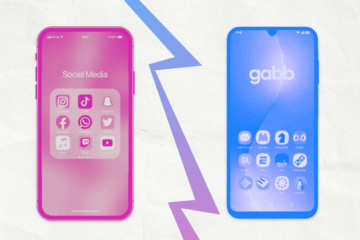
The screen time conversation often starts with the phone itself — specifically with what the phone makes available. For parents of tweens or younger teens, a Gabb phone removes the social media layer entirely, which addresses the highest-hours, highest-risk portion of the screen time picture without requiring daily negotiation.

It doesn’t solve everything — gaming, streaming, and YouTube exist in other forms — but it does change the starting point. That’s the idea behind Gabb, and it’s worth knowing about if you’re earlier in the journey of figuring out what your kid’s first phone should be.

Frequently asked questions

What is the average screen time for a teenager per day? Based on Common Sense Media’s 2021 census, U.S. teens aged 13–18 average 8 hours and 39 minutes of daily screen time, not including school-required device use. That’s up from 6 hours 40 minutes in 2015. Within that total, social media accounts for roughly 4.8 hours per day.

How much of a teen’s screen time is social media? On average, about 4.8 hours per day, according to Gallup survey data. TikTok accounts for the largest single share—around 1.5 hours per teen-reported Gallup data, or closer to 2 hours per Qustodio’s device-tracking figures for U.S. kids. Social media is the fastest-growing portion of teen screen time and the segment with the strongest associations in mental health research.

Is 8 hours of screen time bad for teenagers? It depends on what’s in the hours and what they’re displacing. Research consistently links high screen time to poorer sleep—that’s the most direct concern. Associations with depression and anxiety appear in the data, but the pattern of use may matter more than the total. A teen sleeping well, staying active, and maintaining friendships is in a different position than the raw number suggests.

How does teen screen time compare to tweens? Tweens aged 8–12 average 5 hours 33 minutes of daily screen time, versus 8 hours 39 minutes for teens (Common Sense Media, 2021). The jump between tween and teen years is partly driven by social media adoption accelerating in middle school and high school.

What’s the most effective way to reduce teen screen time? Targeting when tends to work better than targeting how much. Keeping phones out of bedrooms after a set time addresses the sleep disruption finding directly and is less combative than a daily hour limit. Involving your teen in setting the norms also helps—many already want to cut back but don’t know how to start.

Let Us Come to You

Subscribe to the Gabb newsletter to get the top tech safety ideas, stories, and tips.

Comments

Leave a comment

Your email address will not be published. Required fields are marked *

Success!

Your comment has been submitted for review! We will notify you when it has been approved and posted!

Thank you!