





When Thomas Midgley added traces of lead to commercial gasoline, he wasn’t trying to poison the world. He was trying to solve a problem.
By 1921, the automobile industry couldn’t figure out what to do about engines “knocking” — a nickname given to premature ignition, which reduces efficiency and damages engines. Midgley tried just about everything before arriving at leaded gasoline but, once he did, things moved in a hurry. His innovation was patented and pushed widely by the Ethyl Corporation, a joint venture backed by General Motors and Standard Oil.
It was no secret that lead was harmful but there was no empirical evidence proving exposure to lead in this way was causing problems. And a little uncertainty is more than enough to quiet critics when you’ve got the tandem power of mid-century GM and Standard Oil.

We know now, of course, that leaded gasoline is poisonous. Used widely for the better part of a century, the evidence makes it clear that leaded gasoline inflicted significant environmental damage and, “exposed large numbers of people to lead poisoning, which is linked to elevated blood pressure and kidney damage; as well as the impairment of brain development and cognitive function in children.”
That wasn’t Midgely’s goal, of course. He was just solving a problem. At least initially, he likely had no idea he was creating far worse problems in the process.
Despite all the obvious differences, the story behind social media algorithms is disturbingly similar.
How Do Social Media Algorithms Work?
An algorithm is a set of rules, so a social media algorithm just refers to the set of rules that determine what content a user will see when they open up a social media app. The algorithm is just one component of any social media platform, but I say that in the same way I’d say your brain is just one part of your body. It’s critical in ways other parts aren’t.
There are different types of algorithms — search algorithm, brute force algorithm, divide and conquer algorithm, computer algorithms, dynamic programming algorithm, backtracking algorithm, greedy algorithm, and more. — but all computer algorithms are simply a set of instructions.
How social media algorithms operate in the most basic sense are simple:
- Input: Algorithms gather data points (see examples below) to understand a user’s preferences.
- Analysis: Using artificial intelligence (AI) and machine learning, platforms analyze the data to predict what content you’re likely to engage with next.
- Output: The algorithm uses that analysis to show you content it deems most engaging and relevant.
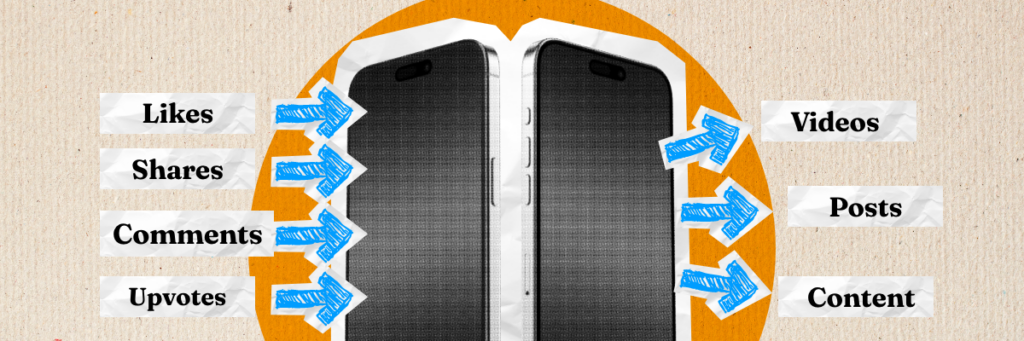
Instagram’s algorithm is a little different than Pinterest’s and that’s different from TikTok’s (hence why these companies are so protective over them), but they all gather similar signals.
Algorithms Signals: What Do Algorithms Track?
Understanding what signals algorithms track is an important step in making sure you’re using social media, instead of letting social media use you. So let’s look at the most common categories.
User Interactions
Your activity — likes, shares, comments, saves, searches, etc. This often includes interactions with specific accounts or types of content.
Engagement Metrics
Likes, comments, shares, saves, upvotes, and so on signal your opinion on content quality and relevance.
Relevance
The content itself is assessed for relevance using keywords, hashtags, and user interests derived from past behavior and preferences.
Recency
Newer posts or content are often prioritized to keep feeds fresh and timely, even if this is no longer the primary factor in ordering your feed.
Account and Content Credibility
Content from accounts with strong reputations, consistent posting, and high engagement tend to be prioritized. Content quality (e.g. video resolution) could also play a role.
Closeness and Connections
The strength of your “relationship” with the content creator. Think things like mutual follows, direct interactions, or shared connections.
Demographics and Location
Location, language (captions or audio), and gender can influence content recommendations, especially for localized trends.
Content Type and Preferences
User preferences for specific content formats — videos, photos, carousels — will lead to similar content types for that user.
Viewing and Watch History
Past viewing behavior, including watch time, replays, and retention.
Trending and Popularity Signals
Content that is popular within a user’s network or region is often given priority visibility.
All of this is indicative of social media as it stands today. For those of you, like me, who joined some of these platforms in the infancy of social media, you’ll remember that things haven’t always been this way.
The Evolution of Social Media: Human-curated vs Algorithm-driven
The sophisticated algorithms spilling content into our feeds today are almost alien to the chronological feeds where this all started in the early 2000s. Initially, platforms like Facebook and Instagram displayed posts in the order they were shared. That’s it. Just a lineup of all the posts, from all your connections, in the order they were posted.

The problem with this beautiful simplicity was that feeds got overwhelming as millions joined these platforms and the number of posts per user grew almost as quickly.
That was the problem that needed to be solved.
And much like Thomas Midgley did with knocking engines, the highly intelligent folks behind these platforms set about to find a solution. Here’s how that went:
2009 – Introduction of Relevance-Based Feeds
Facebook pioneered algorithm-driven feeds by prioritizing content based on user interactions (likes, shares, comments).
2010s – Machine Learning Integration
Platforms began employing machine learning to predict interests. Pinterest’s algorithm used this to suggest pins based on user behavior, while Twitter and Instagram implemented feed ranking based on relevance rather than recency.
2016-Present – Hyper-Personalization
TikTok became dominant with the power of advanced algorithms and its “For You Page,” using nuanced AI models to predict user interests within seconds. OG platforms like Instagram and YouTube followed closely behind and now rely heavily on AI to provide highly personalized feeds and recommendations.
And there you have it. The overcrowded chronological feed is no longer. Problem solved.
But the question we as parents are left to reckon with today is the one we all wish Thomas Midgely and his friends at GM and Standard Oil would have asked 100 years ago:
Is it possible the fix might be causing even bigger problems than it solved?
Are Algorithms Safe for Kids?
No, algorithms aren’t safe for kids. Sorry to put it so bluntly but these algorithm changes are why these platforms are wildly effective at grabbing our attention. Social media is fun for everyone, but not in exactly the same way for any single person. It’s a never-ending stream of content personalized to each user’s unique interests, which is pretty incredible. The drawbacks, however, are real.
Before I get into those drawbacks, let me just acknowledge that my comparison of social media algorithms to leaded gasoline might seem like a stretch to some of you. I think we’ve all had enough fear mongering and we all have plenty to worry about as parents as is. I know I have, and I know I do. But there are a few aspects of tech parenting that probably can’t be overstated and social media’s impact on parents and young people is one of them.
These algorithms are at the heart of these platforms and they don’t just display content — they are shaping how we talk, think, feel, and believe. This is especially true when it comes to our kids.
If you want a deep dive into all the research backing the argument that social media is rewiring kids today, read The Anxious Generation by Jonathan Haidt. If you don’t have time for a full book, read our review of that book. If you don’t have time for another full article (which is fair, so no judgement) just read this quote from the book that pretty much sums it up as relates to the algorithmic impact on kids today:
“In a real-life social setting, it takes a while—often weeks—to get a good sense for what the most common behaviors are…but on a social media platform, a child can scroll through a thousand data points in one hour… Social media platforms are therefore the most efficient conformity engines ever invented. They can shape an adolescent’s mental models of acceptable behavior in a matter of hours.” (59)
Again, just as Mr. Midgley likely didn’t set out to poison people with leaded gasoline, I don’t think the people behind social media algorithms were trying to harm anyone. They were just focused on solving one problem: making their platforms more engaging. Or, in other words, grabbing our attention and hanging on to it.

In another book worth reading (or another book review, if that’s more your thing), Chris Hayes argues that what we pay attention to is really the substance of our entire lives. He writes, “the question of what we pay attention to is the question of what our lives will be. And here we come to a foundational question that is far harder to answer than we might like it to be. What do we want to pay attention to?… You hear complaints about the gap between what we want to pay attention to and what we do end up paying attention to all the time in the attention age.” (253)
That gap is what parents should be concerned about — for ourselves, but especially for our children. The leaders of these platforms would argue that their algorithms are designed precisely to give us as users what we want. But “want” is a tricky word. Let me give you a personal example.
I’m a sugar fiend. I have the palate of a 5-year-old. No joke, I can honestly tell you that most mornings when I wake up the first thought I have is to go to the local bakery to buy doughnuts. I want doughnuts for breakfast every morning. But I also want to be alive when my boys graduate high school. And I want to be in decent enough physical health that I can play with them all the days leading up to that point (and beyond, hopefully).
Social media is really good at giving us the doughnut kind of wants. Not so good at the longterm, deeper, soul-shaping, aspirational wants. And just as my daily desire for doughnuts is in direct conflict with my much deeper desire to have a long healthy life, the signals we send social media algorithms often betray what it is we most want out of life.

Say, for example, you use a particular social media platform to get news. You want to stay informed. Nothing wrong with that.
The algorithm will start serving you the kind of news you engage with and, initially, seem to be helping you do exactly that. But remember, it’s not actually geared toward keeping you informed, it’s geared toward keeping you engaged. And salacious, negative, exaggerated, opinion-affirming news content tends to be more engaging than thoughtful, balanced, nuanced journalism.
So, unless you’re incredibly disciplined, all of your individual taps, comments, and video views will likely begin to signal that you want that unhealthy, doughnut-type content more than the informational, longterm-health type news you set out to get. And if that’s keeping your eyes and fingers on the screen then the algorithm will keep serving it up ad infinitum.
This is the phenomena that produces the well-researched issues we’re seeing today with screen addiction, fake news, echo chambers, eating disorders, skyrocketing mental health problems, and more.
Risks of Algorithms: Why Does This Matter For My Child?
Children and teenagers are particularly vulnerable to the effects of social media algorithms. Their brains are undergoing the second most intense developmental period of their lives (just behind the first few years of life).
This makes them highly impressionable and more susceptible to the psychological and behavioral influences that algorithms can exert. I’ve seen a bunch of experts compare adolescent brains to wet cement, if that helps drive the point home.
So given their susceptibility, let me give you a quick list of the main concerns applicable to our kids:
1. Content Overload
Kids might develop a fear of missing out (FOMO) when algorithms push content that highlights peers’ achievements, vacations, or material possessions. This can contribute to feelings of inadequacy.
2. Addictive Behaviors
Algorithms are designed for engagement. Features like infinite scrolling and autoplay keep young users hooked, which can lead to excessive screen time and reduced ability to focus on offline activities.
3. Exposure to Harmful Content
Even with parental controls in place, algorithms sometimes recommend inappropriate content. I’m sure we’ve all heard stories of posts that promote harmful behaviors or misinformation slipping through filters.
4. Reinforcement of Limited Interests
Algorithms tend to reinforce a narrow set of interests or viewpoints. “Finding oneself” is kinda the hallmark of our middle school, high school, and even college years. Spending time on social media at a young age is likely to push kids into a corner interest-wise where they miss out on broader discoveries or opportunities to engage with diverse ideas.
5. Privacy Concerns
Remember the 3-step process I outlined for how algorithms work? It all starts with input data. Social media platforms collect vast amounts of data to improve their algorithms. The reason these platforms are reluctant to meaningfully respond to privacy concerns is they literally can’t function the way they’ve been designed to function without extracting personal information from us. For kids, this means their online behaviors are constantly tracked, and digital privacy is largely a mirage.
Can I Protect My Kids From the Influence of Algorithms?
When to allow your kids to have social media is a big decision. Some experts argue for waiting until the end of adolescence (due to the above-mentioned brain development). Most agree that kids should be at least 13. But you know your kids and your hopes for them so settle on your own approach.
If you don’t feel your child is ready for social media, but is ready for a device of their own, there are great options now available. Gabb started for this exact reason.
How to Explain Algorithms to Your Kid
If you’ve decided the time is right for social media (or your kid already has it) here are some actionable steps you might consider taking:
1. Explain How Algorithms Work
Break it down in simple terms and use metaphors they’ll understand.
For example, you could tell them it works like a DJ at a school dance. If the DJ plays a hit hip-hop song and everyone cheers and makes their way to the dance floor then she’s going to keep playing hip hop. The DJ is making the choice on each song that’s played but the crowd’s reaction informs those decisions.
2. Encourage Critical Thinking
Teach them to question why they’re seeing specific posts. Is it because they’re interested, or because the platform wants to keep them scrolling?
3. Diversify Content Exposure
Encourage following a wide range of accounts and interests. By interacting with varied content, kids can avoid echo chambers and develop a broader perspective.
4. Set Healthy Boundaries
Limit screen time and encourage offline activities. Discuss the importance of balancing online and offline life.
5. Utilize Parental Controls
Most platforms offer settings to reduce exposure to mature or harmful content. Be proactive in exploring and applying these options.
6. Model Responsible Behavior
If social media is a problem for you, it probably will be for your kids too. This doesn’t mean you have to be perfect. Just try your best to model good habits. And talk about it with them—having regular, honest conversations with your kids about your own struggles could be one of the best ways to teach them.
We’re Up For This
Social media algorithms are powerful, but so are automobiles and electricity. And we’ve figured out how to use them without causing more damage than they’re worth.
If you understand what they are, how they work, how they harm, and what rules you and your kids need in place to make sure they don’t harm your family, there’s nothing to fear. You’re up for this and, when the time is right, so are your kids.
Still have questions? Let us know in the comments below.

Jake was Gabb Now's first managing editor and now contributes as a guest author. He and his wife have three wild little boys. His own writing has been published by Esquire, Forbes, Elsewhere, Iron Horse Literary Review, and others.



Success!
Your comment has been submitted for review! We will notify you when it has been approved and posted!
Thank you!