


What Age Should A Child Get a Cell Phone?
September 13, 2026

From Toddlers to Teens: How to Talk About Healthy Tech Habits
September 15, 2025

Back to School, Back to Tech: Tips for the School Year
August 1, 2025

How to Talk to Kids about Pornography
Gabb's guide for talking about explicit content
July 20, 2026
Yes, Roblox has parental controls. After you create your own Roblox account, verify that you’re an adult, and link it to your child’s account, you can manage their screen time, chat and communication, content maturity, and spending, all from your own phone. The setup takes about 10 minutes. The harder part is knowing what these controls don’t cover, which is what most of this guide is about.
Roblox is not a single game. It’s a platform of millions of user-made “experiences,” with live chat, a marketplace where real money buys virtual currency, and a social layer that can connect your child with people they’ve never met offline. That mix is exactly why a Roblox account needs more deliberate setup than a self-contained game does and why the default account a child creates is not the locked-down account a thoughtful parent would choose.
Here’s the honest, current picture for 2026: what the controls do, how to turn each one on, and where they stop.
How big, and how young, Roblox really is
Roblox reached 144 million daily active users in the fourth quarter of 2025, up 69 percent year over year, and roughly 382 million monthly active users worldwide heading into 2026 (Roblox, 2026). The platform skews young. In early January 2026, Roblox made age checks mandatory before anyone can use chat features. Of the users who had completed that verification by the end of January, about 35 percent were under 13 and another 38 percent were 13 to 17, meaning the clear majority of verified users are minors (Roblox, 2026).
That’s the backdrop for the controls. A platform this large and this young can’t hand-moderate every interaction, so the settings you choose carry real weight.
What changed in 2024–2026 (and why it matters)
Three shifts are worth understanding, because older guides (and the previous version of this article) describe a system that no longer exists.
First, age-based accounts. Roblox no longer treats every child account the same. In June 2026 the company made two age-based account types available globally: Roblox Kids for ages 5 to 8, and Roblox Select for ages 9 to 15. Children are sorted into the right one automatically using facial age estimation, or by a verified parent, and each account type comes with a curated game catalog, stricter default communication settings, and expanded parental controls. There is even a distinct background color in the app so you can tell at a glance which account type your child is using (Roblox, 2026). This is a move from opt-in to what Roblox calls a “safety-by-default” model, where age-appropriate protections are built into the account itself rather than depending on a parent to find and flip every switch. It does not remove your job; it changes where you start. Your child begins in a more locked-down state, and you loosen or tighten from there. Parents also keep access to certain controls until a child turns 16 (Roblox, 2026), so the window you can actively manage is longer than the old under-13 cutoff many guides still describe.
Second, remote management. Since November 2024, parents manage controls from their own linked account and device rather than logging into the child’s account. That’s a meaningful upgrade: you can adjust screen time or block a friend without confiscating the device every night (Roblox, 2026).
Third, mandatory age checks, now ongoing. Beginning in January 2026, Roblox required users to pass an age check before chat features work, sorting people into age bands designed to keep children and adults apart (Roblox, 2026). This addresses one of the platform’s oldest weaknesses, that protections used to depend entirely on the birthday a child typed in at signup. Roblox has since moved toward continuous age assurance rather than a single check at sign-up, using ongoing signals to keep age data current over time instead of relying on one verification moment (Roblox, 2026; Brooks, 2026). It’s a real improvement. It is not a guarantee, which brings us to the part that matters most.
How to set up Roblox parental controls
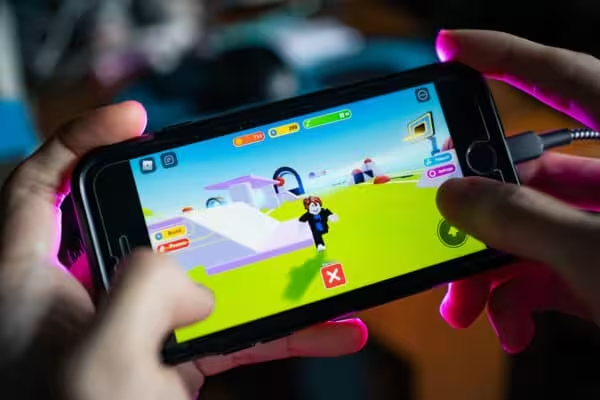
Roblox rebuilt its parental controls in late 2024 and refined them through 2025 and 2026. The old approach, a four-digit Parent PIN entered on your child’s account, has been replaced by a linked parent account you control from your own device (Roblox, 2026). Here’s the current flow. (Exact menu wording shifts between app versions, devices, and regions, so treat these as the path rather than pixel-perfect labels.)
- Create your own Roblox account and verify your age. Sign up at Roblox.com with an email address your child doesn’t have access to, then verify that you’re an adult using a government-issued ID or a credit card. This adult verification is what unlocks parent privileges.
- Link your account to your child’s. From Settings, open Parental Controls and follow the prompts to pair with your child’s account. Once linked, you get a parent dashboard you can open on Roblox.com or in the Roblox mobile app. There is no need to borrow your child’s device every time you want to change a setting.
- Set a screen time limit. In the dashboard, open Screen time and set a daily limit. When your child hits it, Roblox locks them out for the rest of the day. The same screen shows a seven-day average and your child’s top games from the past week, which is useful for spotting what they’re actually playing.
- Set content maturity. Roblox replaced age-based ratings with four content maturity labels: Minimal, Mild, Moderate, and Restricted. Choose the level that fits your child, and use Allowed Games and Blocked Games to make exceptions for specific experiences. A blocked experience stays blocked regardless of its maturity label. Note that this is changing. Roblox has said it will transition later in 2026 to the International Age Rating Coalition (IARC) framework, which means U.S. families will start seeing familiar ESRB ratings, and European families PEGI ratings, the same systems used for console and PC games (Roblox, 2026).
- Set chat and communication. Chat settings are now tied to your child’s age-based account. On the youngest accounts, if you choose to allow chat at all, it is text only and limited to users in the same or similar age group or to Trusted Friends, a designation for people your child actually knows (Roblox, 2026). Text filters and chat rephrasing are always on, and until your child turns 13 you can review their friend list, block or report anyone, and approve or decline Trusted Friend requests (Roblox, 2026). Voice chat remains off by default and requires an age check to enable. For most elementary-aged kids, leaving chat off or limited to Trusted Friends is the safer default
- Set a monthly spending limit. Roblox runs on Robux, its virtual currency, bought with real money. Set a monthly spending cap and turn on spend notifications. The dashboard’s spending summary breaks down recent purchases by experience, which makes unusual patterns easy to spot.
- Check the dashboard regularly. The controls aren’t “set it and forget it.” Reviewing screen time, the friends list, and recent games every week or two gives you real information for ongoing conversations and catches problems early.
Quick start: If you only do one thing today, do step 1 and step 2, create your parent account and link it. Every other control lives behind that link.
Do Roblox parental controls actually work?
Short answer: they work well for the things they’re designed to control, and not at all for the things they aren’t. Treating them as a complete safety solution is the mistake that gets parents into trouble.
What they handle well. Screen time limits, spending caps, content maturity, and chat restrictions are genuinely effective on the account you’ve configured. If you’ve linked accounts, set chat to friends-only, and capped spending, you’ve closed off the most common day-to-day problems: runaway Robux charges, late-night play, and most stranger contact inside the app.
Where they stop. Online enticement, an adult contacting a child for sexual purposes, happens across every kind of platform, including online gaming (National Center for Missing & Exploited Children [NCMEC], 2026). In 2025, the NCMEC CyberTipline received about 1.4 million reports of online enticement, a 156 percent jump from the year before, including more than 80,000 reports involving sextortion (NCMEC, 2026). Financial sextortion in particular has overwhelmingly targeted teenage boys (Thorn & NCMEC, 2024). Roblox reports suspected exploitation to NCMEC and, through 2025 and 2026, faced lawsuits and investigations from several U.S. state attorneys general over how predators have used the platform—unproven allegations currently working through the courts, not settled findings (Roblox, 2026). No in-app setting fully solves this, for a few concrete reasons:
- Off-platform luring. The riskiest move isn’t a message inside Roblox; it’s someone persuading your child to continue the conversation on Discord, Telegram, or Snapchat, where Roblox’s filters don’t reach. Your controls end at the edge of the app.
- The controls only cover the account you set up. A second account, a sibling’s login, or a friend’s device sidesteps everything you’ve configured.
- Spending has gaps. Robux can be gifted between players, and many games use loot-box mechanics which is paying for a random chance at a rare item that functions a lot like gambling for kids. A monthly cap doesn’t address either directly.
- Engagement is the design. Roblox is built to keep players coming back, which is why a screen time limit is a starting line, not a finish line. (If gaming has started to crowd out everything else, our guide to video game addiction covers the warning signs.)
None of this means Roblox is uniquely dangerous, and it isn’t a reason to panic. It means the controls are one layer. The other layers are yours.
For the fuller risk picture, explicit user-generated content, contact with strangers, and how to weigh whether the platform is a fit for your child at all, see our companion guide on whether Roblox is safe for kids. It pairs naturally with this one: that guide answers “should my child be on Roblox,” and this guide answers “if they are, how do I set it up.”
What parents can do beyond the in-app controls
The settings are the easy 20 minutes. These are the part that actually protects a child.
Have the conversation the controls can’t. The most durable protection is a child who believes they can bring you a problem, a creepy message, an accidental purchase, a “friend” who turned out not to be one, without losing the game they love. State the risks calmly and factually, then move quickly to what you’ll do together. If you want a script for the harder topics, our guide on how to talk with your child about online predators is a good starting point, and recognizing the early signs of recognize the signs of cyberbullying helps you spot trouble before your child names it.
Roblox has also built a tool for exactly this. In July 2026 it launched Family Zone, an in-game experience made with developer MindTrust that teaches parents about the platform, its parental controls, and broader online safety, with kids often guiding their parents through it (Roblox, 2026). It is not a substitute for your own conversations, but it is a low-pressure way to learn the platform alongside your child rather than over their shoulder.
Know which games they’re in. Roblox experiences trend in and out of popularity fast. Ask for a tour; “show me your favorite world today”, rather than reading thumbnails. (Some current crazes, like trending Roblox games like Steal a Brainrot and Dress to Impress, are mostly harmless but worth understanding.)
Keep gaming in shared spaces. For younger kids especially, Roblox on a family computer or console in a common room is easier to keep an eye on than Roblox in a pocket.
Consider whether the device needs internet at all (yet). If your child mostly needs to call, text, and be reachable, a phone without app stores or open internet removes the question entirely. That’s the idea behind Gabb®; devices like the Gabb Watch and Gabb Phone give kids real independence without an open door to platforms like Roblox before you think they’re ready. It’s not the right answer for every family, but for younger kids it’s worth weighing against a full smartphone.
The goal isn’t fear. It’s a setup you’ve configured thoughtfully, a child who knows they can come to you, and the judgment to know the controls are a tool they are not a total solution.
Frequently asked questions
Does Roblox have parental controls? Yes. Roblox offers parental controls for screen time, chat and communication, content maturity, and spending. You manage them from your own Roblox account after verifying your age and linking it to your child’s account, using the parent dashboard on Roblox.com or the Roblox mobile app.
How do you put parental controls on Roblox? Create your own Roblox account, verify that you’re an adult with a government ID or credit card, then link your account to your child’s from Settings, then Parental Controls. Once linked, you can set screen time, content maturity, chat settings, and a monthly spending limit from your parent dashboard.
Can you put parental controls on Roblox for free? Yes. All of Roblox’s built-in parental controls are free. They’re part of the platform — you don’t need a paid subscription or a separate app to set screen time, chat, content, or spending limits.
Are there parental controls for kids under 13 on Roblox? Yes, and accounts registered as under 13 get extra protections automatically, including tighter content filtering and chat limited to “Friends” or “No one.” Younger children need a parent’s consent to enable direct chat, and voice chat is off by default.
How do you change Roblox parental controls? Open your parent dashboard on Roblox.com or in the mobile app, go to Settings, then Parental Controls, and select your child’s account. From there you can adjust screen time, content maturity, chat, allowed and blocked games, and spending limits at any time.
Do Roblox parental controls actually keep kids safe? They’re effective for what they control. Whether that is screen time, spending, content level, and in-app chat. But they can’t reach off-platform conversations, a second account, or another device, and they don’t replace ongoing conversations with your child. Treat them as one layer of safety, not the whole solution.
References
Roblox. (2026). Q4 and full-year 2025 shareholder materials and parental controls help center. https://about.roblox.com/parental-controls
National Center for Missing & Exploited Children. (2026). The work never stops: A first look at NCMEC’s 2025 data. https://www.missingkids.org/blog/2026/the-work-never-stops-first-look-at-ncmecs-2025-data
Thorn, & National Center for Missing & Exploited Children. (2024). Trends in financial sextortion: An investigation of sextortion reports in NCMEC CyberTipline data. https://www.thorn.org/research/library/financial-sextortion/
Roblox. (2026, April 13). Introducing Roblox Kids and Select accounts. https://about.roblox.com/newsroom/2026/04/introducing-roblox-kids-and-select-accounts
Roblox. (2026, June 16). Age-based Roblox Kids and Roblox Select accounts now globally available. https://about.roblox.com/newsroom/2026/06/age-based-roblox-kids-and-select-accounts-now-globally-available
Roblox. (2026, May 20). What families need to know about Roblox’s new age-based protections. https://about.roblox.com/newsroom/2026/05/what-families-should-know-roblox-kids-select
Roblox. (2026, July 14). Roblox’s Family Zone helps parents and children explore together. https://about.roblox.com/newsroom
Brooks, M. (2026, August 11). Roblox rolls out parental controls, community tiers and ban warnings. Northeast Times. https://northeasttimes.com/2026/08/11/roblox-rolls-out-parental-controls-community-tiers-and-ban-warnings/

More than a cellular company—Gabb is a movement to connect kids to what matters most with safe technology solutions.



Success!
Your comment has been submitted for review! We will notify you when it has been approved and posted!
Thank you!